|
Pioneer
Cemeteries and Their Stories, Madison County, Indiana |
 |
|
Pioneer
Cemeteries and Their Stories, Madison County, Indiana |
|
|


Location: north side of 8th Street/8th Street Road/West 8th Street, between CR 900W and SR 13
 |
|
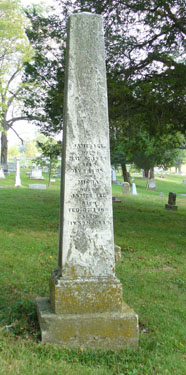
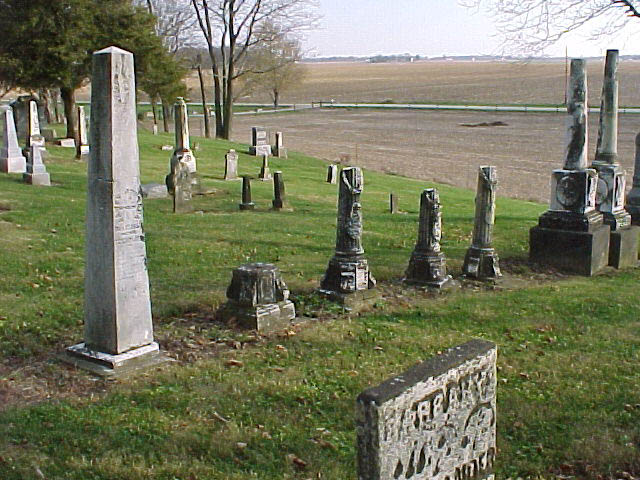
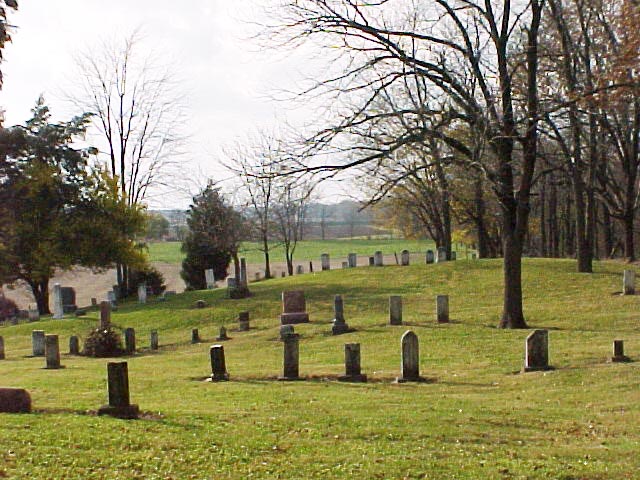
An early settler to the Perkinsville area was James Johnson whose tall white obelisk is on the left. He died in 1865 at seventy-two years old, making his birthday around 1793. Extending to the right of the obelisk are the columns, broken by design, of Johnson family members. These grave markers are at a high point on the hilltop. To the left is White River; to the right down the hill is the old settlers' trace, now called West 8th Street, stretching through the November Hoosier farmland. |
The Perkinsville Cemetery is between two important elements in the early civilization of Madison County: the White River and South Bank Road. South Bank Road was also called River Road, Strawtown Trace, and later Strawtown Pike; it is now named West 8th Street. Those pioneers and settlers coming from anywhere east of the New Purchase had a choice of entering the open territory either by floating on rafts down White River or by walking with their ox-drawn wagons lumbering on the trails and traces bordering the river's banks. South Bank Road, a foot path by modern standards, became the popular route of travel west, and it is hard to estimate how many hundreds of settlers moving into the New Purchase used this route in the early 1800s.
Because the land along South Bank Road was the most accessible, it was populated early and therefore contains a number of pioneer cemeteries. The Perkinsville Cemetery is one of these. This burial ground is southeast of and across the river from the hamlet of Perkinsville, which is on the north bank. The burial ground is approached from West 8th Street; the beautiful hills on the north side of the road form the south bank of the river. The old stones are at the west end, closer to Perkinsville; the new stones are at the east end. The Perkinsville Cemetery is one of the largest and best preserved pioneer cemeteries in the county. Some of the first settlers to the township and, indeed, to Madison County rest in its rows.
 |
|
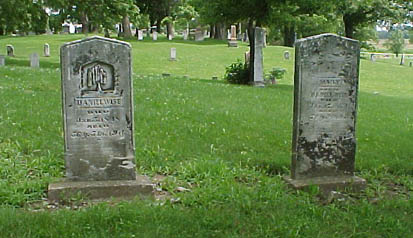
Daniel Wise, 1792-1848, who came in 1822 from Ross County, Ohio, entered 400 acres south of the river in sections 3 and 34. This was the first land entry made in Jackson Township. In 1825, the first primitive school was built on his property. In 1826, a small log school, an improvement, was also constructed on land donated by the Wise family; the Wise children attended. As early as 1828/9, Daniel built a beautiful Federal style brick home along the Strawtown Trace, later known as West 8th Street. (For a picture, go to the Madison County history page.) Daniel Wise and his family settled the land he purchased, and his descendents stayed in the area. He put down his own roots as evidenced by the generations of Wise family members who are ensconced in rows at the Perkinsville. Daniel and his wife Mary, 1799-1869, are buried next to each other, and their gravestones, pictured above, are in excellent condition. |
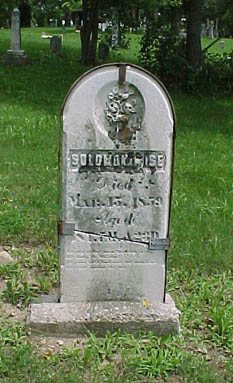 |
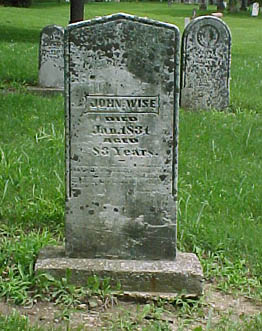
Soloman Wise, 1800-1859, whose stone is pictured on the left, would have been from Daniel's generation. However, John Wise, whose stone is pictured on the right, was Daniel's father, according to family researcher Karen Richardson Gee. John Wise died in January 1831 at eighty-three years of age. That puts his birth year around 1748. So far, John Wise is the person with the earliest birth date buried in Madison County with a legible gravestone. |
 |
|
|
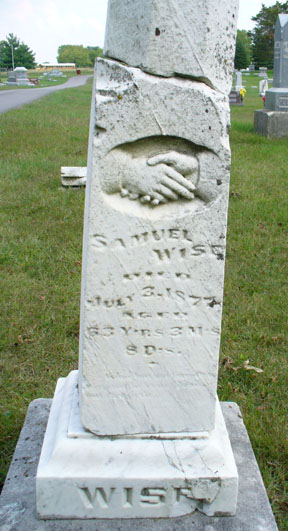
The marker for Samuel Wise, c.1814-1877, at left, shows the familiar Victorian symbol for husband and wife, the clasped hands, which stood for their partnership in life and fellowship in the after-life. Samuel was a grandson of patriarch John Wise, discussed above. While many of the Wise children and grandchildren remained in Madison County, a branch of Samuel's family moved west and eventually settled in Texas where their descendants can be found today. There are over sixty members with the Wise surname on the burial list for the Perkinsville Cemetery. |
|
|
|
|
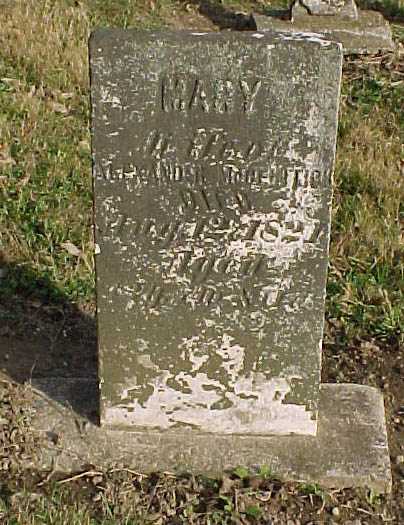
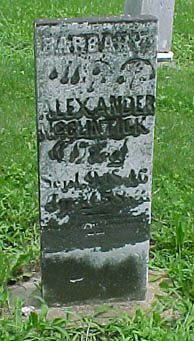
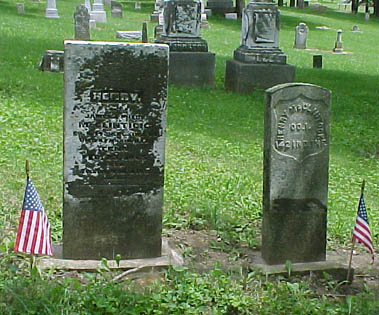
Another large family who remained is that of George, 1812-1876, James, 1815-1894, and patriarch Alexander, c. 1775-1848, McClintick/McClintock. Alexander and his extended family helped civilize the wilderness bordering White River. The McClintocks also have multiple generations represented in the Perkinsville Cemetery. Alexander's first wife was Mary Kerr McClintick, who died shortly after arriving in Jackson Township. Mary has a legible gravestone, left, which reads, "wife of Alexander, died Aug. 12, 1821, 43Y. 7M. 11D. " The 1821 date of death makes Mary's passing one of the earliest in the county. Her grave marker was installed by later descendants. Barbara Wise McClintock, 1788-1846, whose stone is in the middle, was Alexander's second wife. The picture on the right shows the gravestones of descendant Henry McClintock, 1844-1865, who was killed in the Civil War. He has two markers, one from the government and one from the family.
|
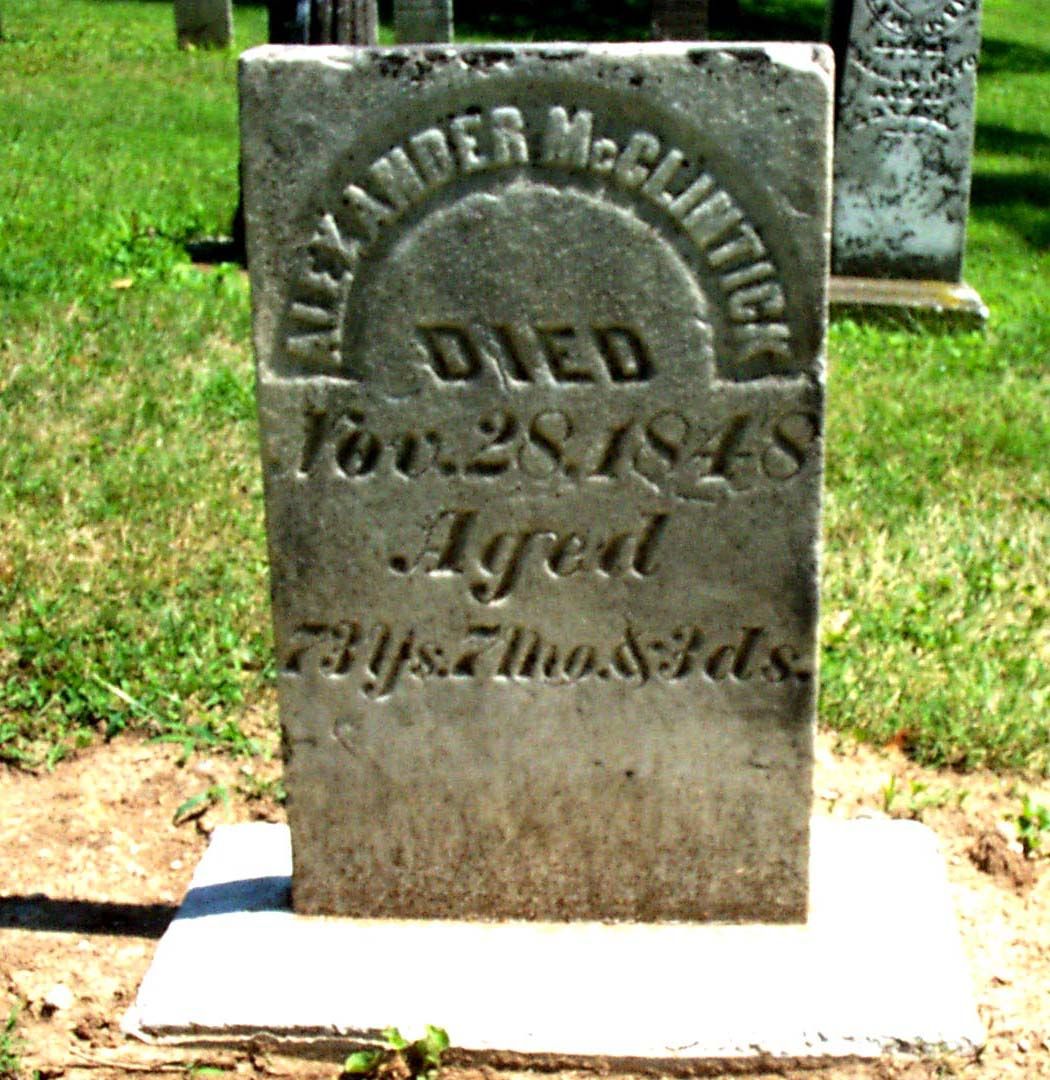
Patriarch Alexander McClintick's stone, right, has recently (2009)been cleaned and given a new base by seventh generation descendant Norm Bracken who also provided this excellent picture. Now the incising shows wonderfully crisp and legible; even the periods after the abbreviations are defined. Alexander "died Nov. 28, 1848 aged 73ys. 2mo. & 3ds." That would make his birth year around 1775.
|
|
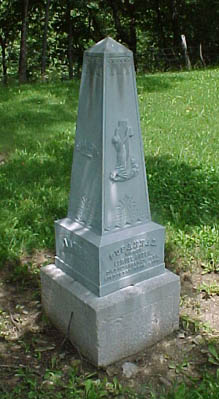 |
Lemuel Auter , 1795-1833, is listed by the American Legion as a veteran of the War of 1812, buried in grave 4, row 4, lot 2. Lemuel and his brother John, 1771-1830, came to Jackson Township before 1824 with their families. Lemuel's daughter Sarah was the first birth in the township; she died in 1859 and is also buried here. Lemuel Auter's wife Susannah is buried next to him. Their early 20th century marker, pictured at left, was placed here with its new base by their descendents. An unknown soldier of the War of 1812 is also listed in the American Legion's Cemetery Record of Deceased Veterans. This un-named veteran is buried in grave 1, row 2, lot 16 at Perkinsville Cemetery.
|
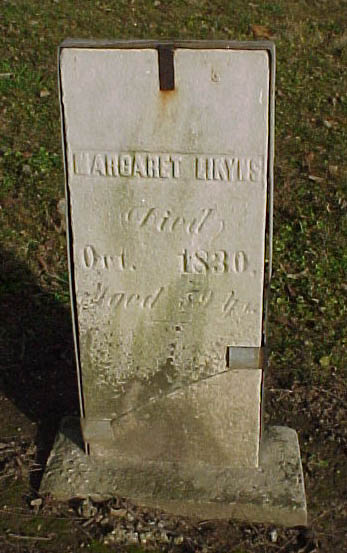
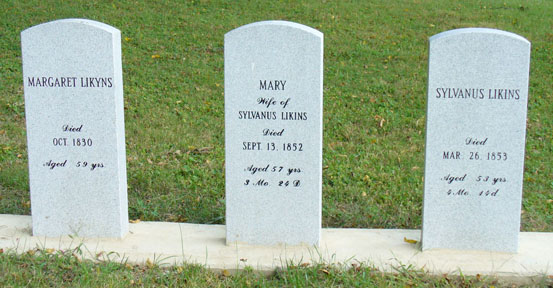
In 2004, Margaret Likyns' simple stone, below left, was one of the oldest still existing. Clearly legible, the stone records that she died, "Oct. 1830, aged 39 yrs." As of 2008, however, Margaret's stone as well as a few others of the family had succumbed to time and the elements. In their place were the new stones, pictured below right. The Likyns/Lykins family is listed by historian Samuel Harden as pioneers to Jackson Township. Their descendants evidently are proud of their heritage and are dedicated to preserving it for future generations.
|
|
 |
|
|
|
|
Family members of other first land owners are represented above. At left is the pillar for Martha Jane Cole who died in 1874 at thirty-six years. In the oval is a hand, drooping in mourning. It is holding a single link symbolizing the break in the family chain. Relative Becknell Cole was an area merchant and helped lay out the village of Perkinsville. In the middle is an interesting grouping for the Dyer family. At right is a stele for James Lee. There were three among the early settlers with that name: the patriarch who died in 1824 at thirty-one years old, a son who was only twelve when he died in 1853, and an adult who lived to be forty and died in 1865.
|
|
|
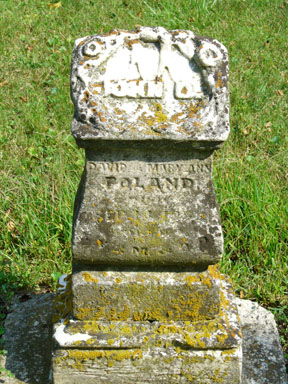
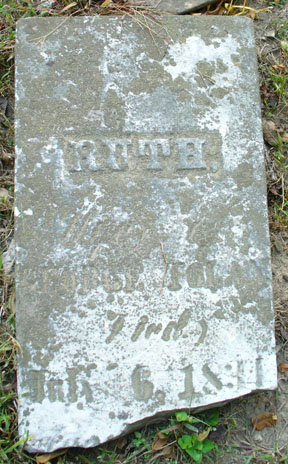
The Foland family is also listed by historian Harden as pioneer settlers to Jackson Township. At near left is wife Ruth who died July 6, 1834. At far left, John O., son of David and Mary Ann Foland, lived for almost six weeks. He died in 1862. His Victorian marker's top was once covered with incised flowers. |
|
|
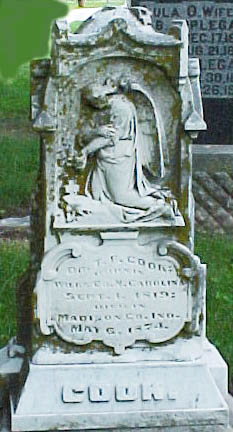
In contrast to the simpler stones above is Dr. T.F. Cook's elaborately decorated Victorian memorial, left, a genealogist's dream. The medallion under the mourning angel reads: "Dr. T.F. Cook was born in Wilkes Co., N. Carolina Sept. 1, 1819 and died in Madison Co., Ind. May 6, 1874." |
|
|
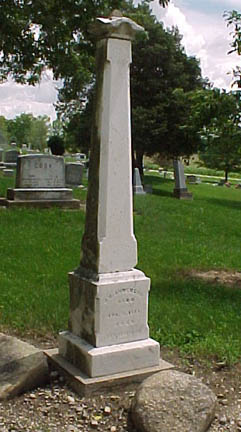
Representative of the Anderson family is the white corniced pillar at left. A number of settlers of this surname were very long lived for their time. Henry died in 1887 at ninety years; J.H. was seventy-seven when he died in 1881; Lydia was eighty-one years old in 1895 when she passed away; and Nancy died in 1878 at the age of seventy-seven years. There are twenty-four members of the Anderson clan buried at the Perkinsville. |
|
|
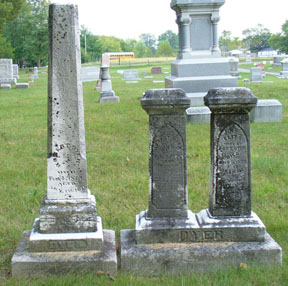
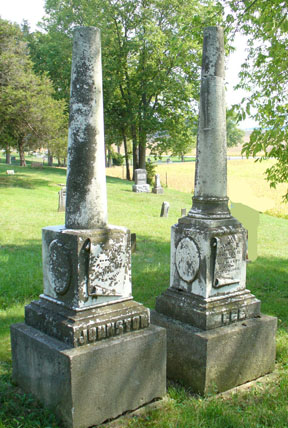
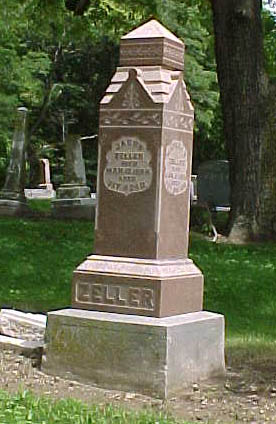
These two attractive matching columns on bases, left, indicate how close two families can become through marriage, migration, geography, and business. The one on the left is for members of the Johnston/Johnson family; its sibling to the right is for members of the Lee family. One of the first entrepreneurs to the area was Jacob Zeller, right. Jacob's mill, once located on nearby White River, turned settlers' grains into flour and meal, and their timber into lumber. Thus, he helped his community survive. |
|
|
|
|
|
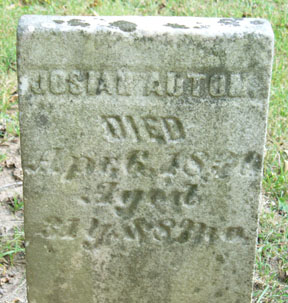
While pillars seemed to have been a very popular style of marker for many of those buried at the Perkinsville, tablets of various shapes are also abundant. Josiah Auton's, middle, states he died "April 6, 1830 aged 31ys. & 8mo." While the script on Elizabeth's stone, right, is still very crisp, Mary Staple's data can barely be deciphered. The clasped hands--the partnership of man and wife--in the oval represent her married status. Mary was forty-one years old when she died March 25, 1845.
Buried at the Perkinsville is one of Madison County's first prominent citizens--Thomas L. Beckwith. Thomas was born in New York May 24, 1815, and was brought by his parents Zenas and Mary to the Hoosier frontier in 1820. At the age of fifteen he started working for Becknell Cole, an early merchant in Madison and Hamilton counties. In 1836, Mr. Beckwith came to the Perkinsville area, and he and Cole laid out the plat for the village. (For more on Perkinsville history, go to the Jackson Township page.) Beckwith remained and began a successful business, selling general merchandise. The business lasted for forty years. Thomas was also Perkinsville's first postmaster, a position he held for almost as long. He also farmed the land and raised stock. Between 1840 and 1850, the days before railroads, Beckwith would purchase large herds of cattle and hogs and drive them to the nearest market--Cincinnati. He was president of the Anderson/Perkinsville Turnpike Company until its completion, township trustee for two terms, county commissioner for one, county treasurer, and a candidate for the state assembly. In his later years, he was instrumental in organizing the "old settlers' meetings," as historian Samuel Harden refers to them, in Perkinsville. There were, in fact, no such meetings held in the local area after Beckwith's death in 1878. Thomas Beckwith's home and store are pictured in the 1880 History of Madison County, Indiana, page 110.
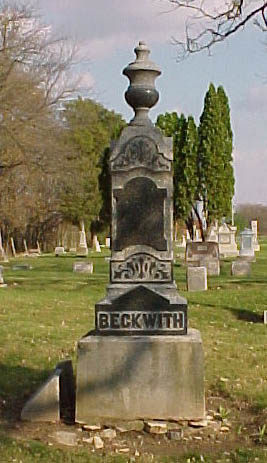 |
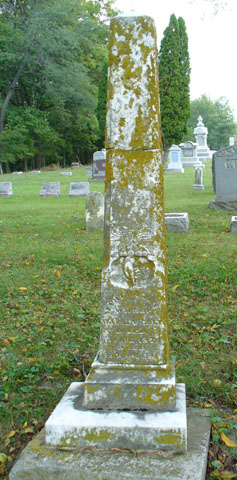
Of Thomas Beckwith, Samuel Harden writes, "...few men knew more than he of early life in the woods. Being well informed on all subjects, it is no wonder that he was held in high esteem." The monument to Thomas Beckwith, 1815-1878--businessman, commissioner, farmer, trustee, postmaster--is pictured on the left. |
Click here for a list in pdf format of burials with headstones.