|
Pioneer
Cemeteries and Their Stories, Madison County, Indiana |
 |
|
Pioneer
Cemeteries and Their Stories, Madison County, Indiana |
|
|


aka Menden/Mingle
Location: southwest corner of SR 9 and CR 1050S
|
|
|
|
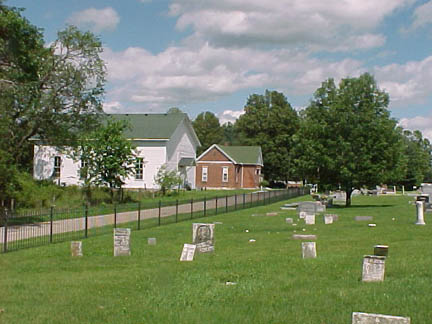
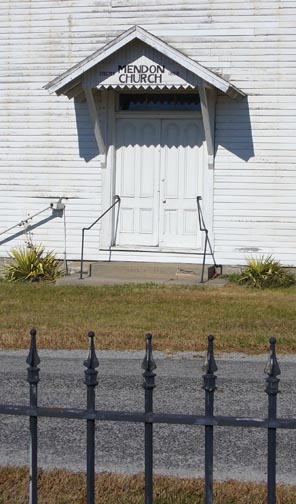
In the picture above left, the white Mendon Church, erected in 1868, represents the congregation of early settlers who erected their first house of worship at this site around 1831. Now this second frame edifice sits, as its predecessor did, across the road from the congregation's original burial ground, the Mendon Cemetery. The building is an excellent example of 19th century craftsmanship. A stone, below, near the door explains that the church was completely hand made and that the podium and pews are from native yellow poplar. The church, in fact, is still used. Descendents of the original settlers hold an annual meeting here "to commemorate the valiant pioneers who sacrificed so much." The brick school house #11, to the right of the church, has been converted into a private residence.
|
The Mendon Cemetery receives its name from the Mendon/Menden post office. At the intersection of CR 1050S and what is now SR 9, almost on the southern boundary of Madison County, the Mendon post office stood for about twenty-five years. Early settler Thomas Jordan built a store at this intersection and stocked it with merchandise. Shortly thereafter, he sold out to Morgan Drury who operated the store and established the post office. Drury was the appointed postmaster, and he ran the office out of his house. His house was on the northwest corner of the intersection.
Around 1831, a Methodist Episcopal Church was formed and subsequently erected a house of worship to the west of Mr. Drury's home/post office. At about this time, across the county road from these buildings, the cemetery was also designed for the congregation. In 1844, a United Brethren Church was added in the southwest corner alongside the cemetery. Evidently both churches, as well as area residents of what was called "Menden," used the cemetery. Mendon even had doctors who practiced there over the years: Drs. Richison, Wiseman, and Williams.
Mendon never became a town or village, in spite of its buildings and businesses, because the area was never platted or laid into town lots. The two churches and school house #11 are represented on the 1876 township plat map for Fall Creek even though the last postmaster, Jonathan Wiseman, resigned his position in 1850/1 and the last store merchant was Elliot Irens.
Among the pioneer families that made use of the Mendon Cemetery were the Mingles. There are many generations of Mingles buried in the old section, so much so that at one point the cemetery was even referred to by the Mingle name. A patriarch of this family was John Mingle who fought in the Revolutionary War.
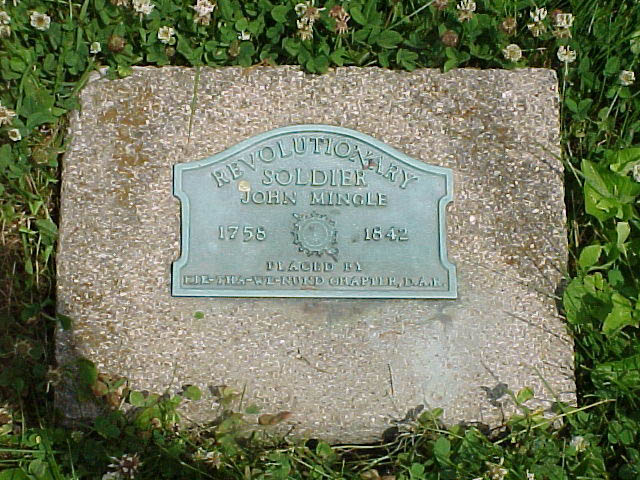 |
John Mingle is listed in the DAR Index of Patriots. He was born in 1758 and came to the southern part of Madison County along Lick Creek with his family in the 1820s. He built a homestead near the little settlement of Menden. A historical note also has him titled as a reverend. He died in 1842 at eighty-four years of age. Another pre-Civil War veteran is Prentis Champlain buried in grave 1, lot 99, block 2. He is recorded in the American Legion's Cemetery Record of Deceased Veterans as a soldier during the Mexican-American War in the late 1840s. His gravestone has no birth or death dates, but it does have his regiment: "Co. D 4th Ohio Infantry." |
|
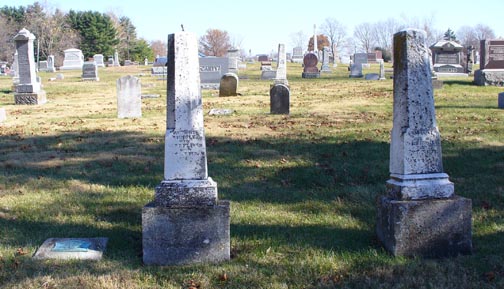
John Mingle's flat DAR commemorative is placed beside descendant George Mingle's larger monument. Evidently, there is no traditional marker on John's grave, and the burial site's location is unknown. The markers pictured right are in the oldest section to the west.
|
|
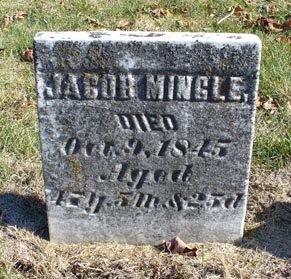
Jacob Mingle, whose stone is below left, provides another distinction for the Mingle family. This may be the Jacob Mingle who had the first tavern in Pendleton. According to the 1880 Kingman history of the county, "[Jacob]... opened his house for the accommodation of travelers. His house was a frame building, and was located on the south side of State street, west of Main. His patrons were principally immigrants, seeking homes at various points in the State, and although the tavern was not faultless in its appointments and accommodations, it was infinitely preferable to the open air or the covered wagon." Jacob died "Oct. 9, 1845 aged 45y 5m & 25d."
An additional Mingle family member is Malinda, below right, "wife of G.W. Mingle died March 17, 1878 at 35y 11m 2d."
|
|
|
|
|
|
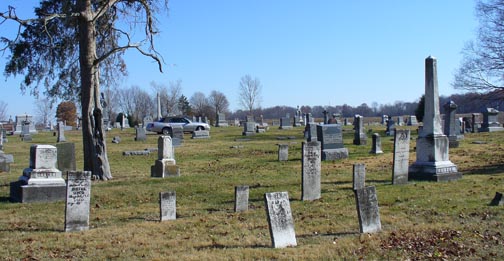
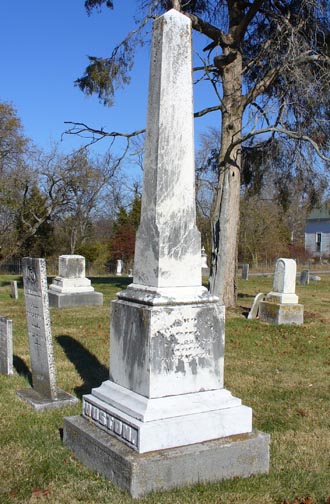
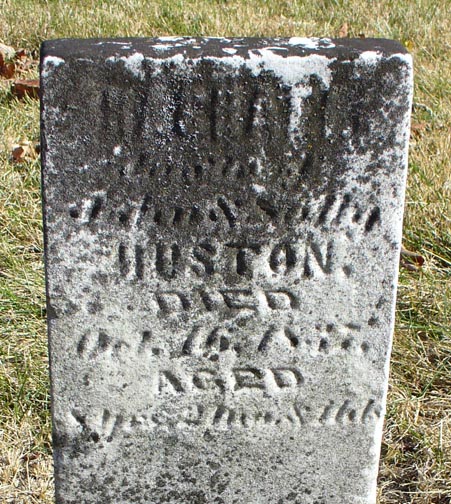
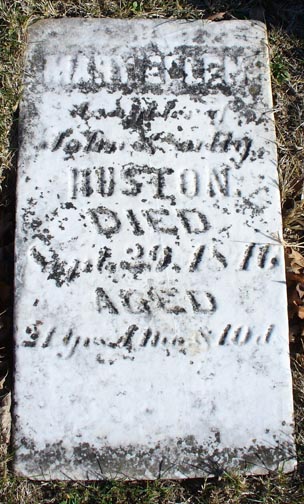
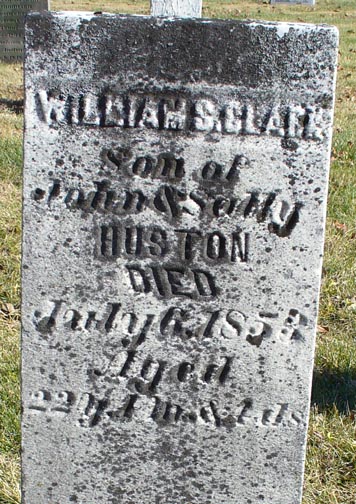
The Hustons were among the earliest families to southern Madison County. There are twenty-six of that surname on the attached burial list for this cemetery. John Huston's attractive obelisk is at right in the above picture of the Huston section. He lived to be "71y 7m 7d" and died in September of 1874. His wife Sally lived to be "58y 8m 16d" and died in April of 1864. From the late 1830s through the early '50s, John and Sally lost five children--left to right below: Rachel, Louise, Mary Ellen, Willaim S. Clark, and Theadore G.-- attesting to the severity of pioneer life. Their grave markers are well preserved and quite legible.
|
|
|
|
|
|
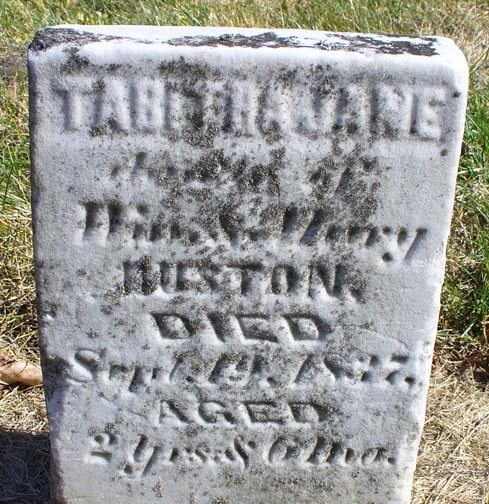
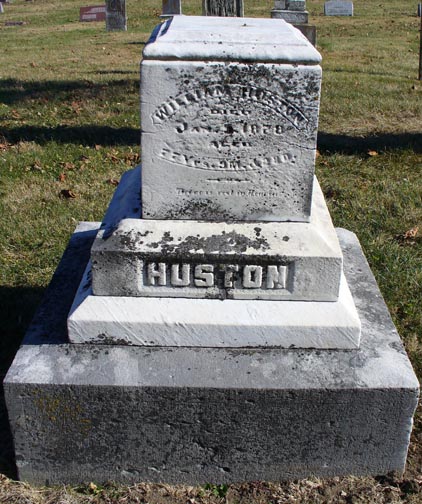
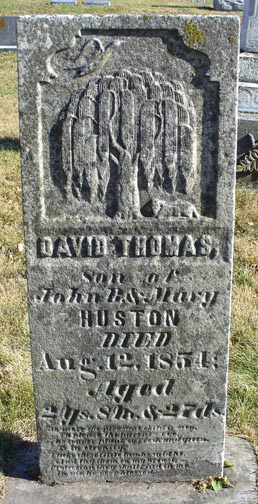
Huston relative William, center below, is listed among the first land owners in neighboring Green Township. William was "77y 9m 28d" when he died January 1, 1878. Members of the extended Huston family, Tabitha Jane, left, and David Thomas, right, were both two years old when they died in 1837 and 1854 respectively. The latter's stone is remarkably well preserved--even to the tradition poem at the very bottom.
|
|
|
|
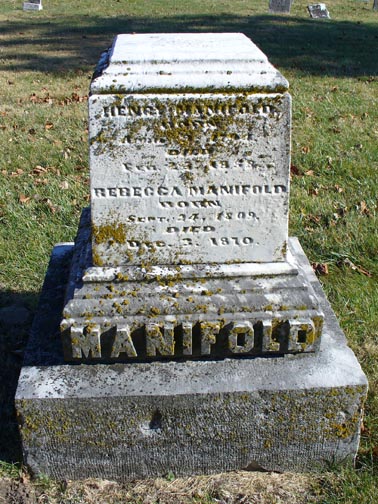
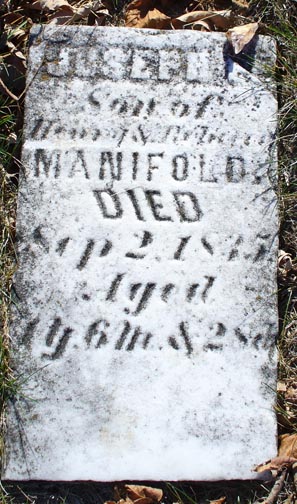
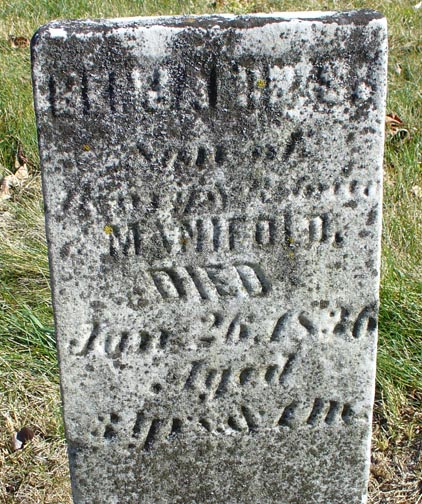
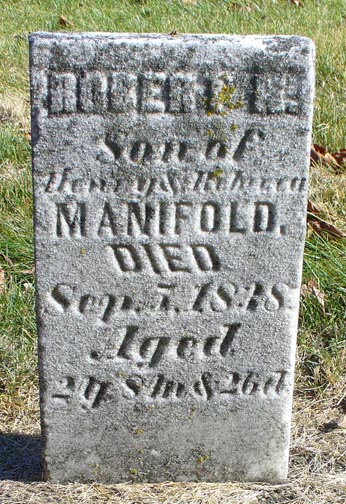
The Manifold family is also listed among the first land owners to southern Madison County, and there are multiple generations of this family buried within the extent of the Mendon Cemetery. One of the patriarchs of the family was Henry Manifold who was born April 9, 1794, and died February 25, 1895. His wife Rebecca is recorded on the same base, below left, as being born September 24, 1808, and passing away December 3, 1870. Three of their children, Joseph, Benjamin, and Robert, died in the 1830s.
|
|
|
|
|
|
|
From a later generation than Henry, John Manifold has an obelisk near Henry's base. John was aged "34y 1m 10d" when he died November 16, 1874. |
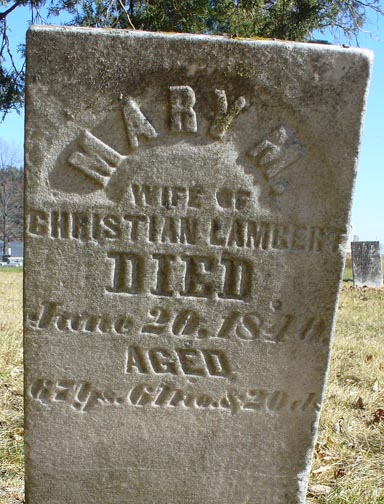
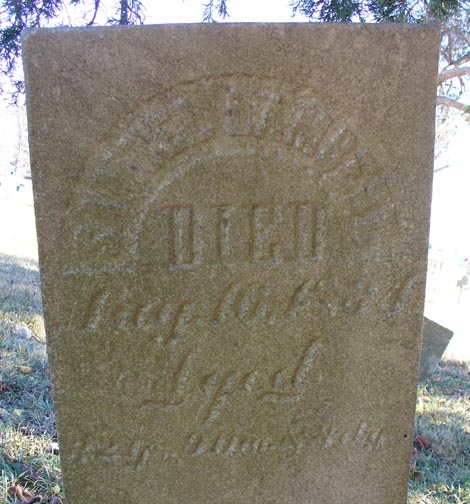
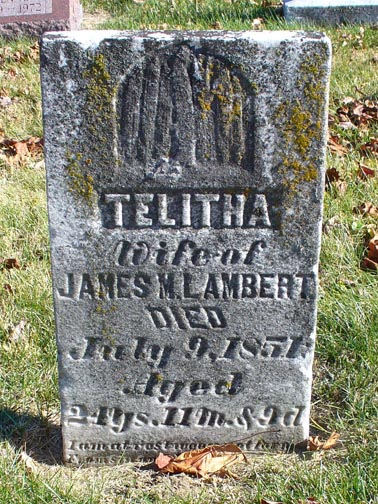
The early dates on the grave markers, below, for the Lamberts place this family among the pioneer settlers to the area. The nine members recorded as buried at the Mendon all have death dates on or before 1851. Mary M., left, who died in 1840 at the age of sixty-seven would have been born around 1773. She may have one of the earliest birth years of anyone in this cemetery. Samuel died in 1834 at thirty-two years old. His is one of the oldest stones still existing. Abraham died in 1838 at thirty-three, and Telitha was twenty-four when she passed on in 1851. Christian, husband of Mary, is listed on the Mendon's burial list, but James, Telitha's husband, is not. While the Mingles, Hustons, and Manifolds had multiple later generations residing in the area, the only Lamberts reposing here are from the first half of the 19th century.
|
|
|
|
|
|
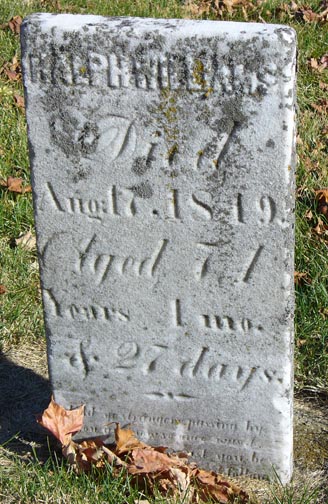
Another individual who was born in the 18th century is Ralph Williams at right. He was seventy-one years old when he died in 1849. That would make his birth year around 1778--the time of the American Revolution. |
|
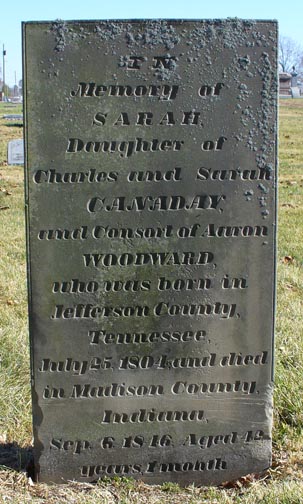
Many of the earliest stones in the old west section of the Mendon Cemetery are tablet type markers--like the majority of those shown above. White marble was used for this style after the first third of the 19th century. It was around that time that memorial architectural styles changed from sever tall granite slabs, like that for Sarah Canaday Woodward, below left, to shorter white marble tablets like that for her husband Aaron, below right. Marble became more popular because it was easier to cut and therefore could be decorated with the Victorian motifs of flowers, hands, trees, and doves, etc. Marble, however, fades and deteriorates quickly and blackens with mold. Granite is harder and so remains legible and more stable. Additionally, in the last half of the 1800s--if the family wanted something more substantial--three dimensional markers began to be offered. Pillars, obelisks, urns, finials, human figures, and podiums with books, drapes, and cartouches could be rendered, and for Victorians every object added to the stone's design symbolized a message.
|
|
A deeply cut stone, left, is that for "Sarah, daughter of Charles and Sarah Canaday and consort [wife] of Aaron Woodward, who was born in Jefferson County, Tennessee, July 25, 1801 and died in Madison County, Indiana Sep. 6, 1846. Aged 45 years, 1 month." A genealogist could ask for no more from a grave marker. This stone is a brownish gray because it is granite, not the soft white marble like that of her husband's marker, right. Granite was used in the first third of the 19th century with marble being preferred thereafter. Starting in the 1830s, Victorian fashion dictated that stones be more ornate and decorated, and marble is softer for carving these. Sarah's husband Aaron, right, died two years after Sarah when he was forty-five years old. While Sarah's stone has two fonts and straight lines, Aaron's has four fonts and an arched name.
|
|
|
|
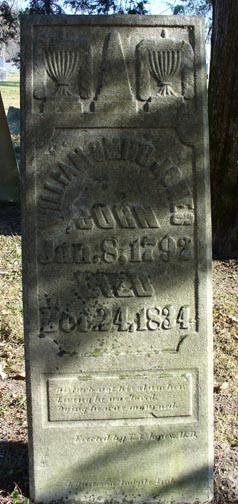
Another excellent example of gravestones from the early 1800s is that for William Smith Jones, left. About three and a half feet tall and three inches thick, the granite surrounding the lettering and decorations has been cut away to project the figures out; thus, this stone has been carved in "relief" as opposed to Sarah's above which has been incised or cut into to make the figures. Also, the stone has a poem within an incised rectangular frame below the data. This marker is one of the rarest in the county because it bears the name of the man who erected it:"H.H. Jones, M.D." Additionally, at the very bottom the business that produced the marker is also included, a shop in "Indplis [Indianapolis], Ind." The simple two dimensional pyramid and urns with drapes at the top will continue to be fashionable through most of the century, even becoming popular three dimensional configurations. |
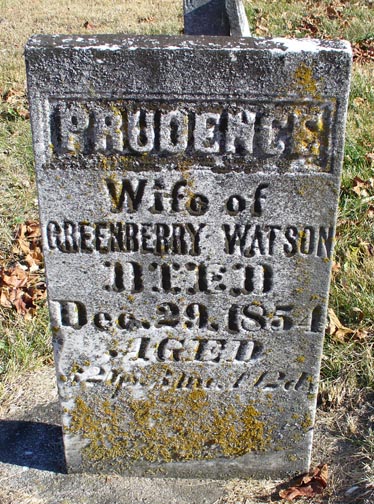
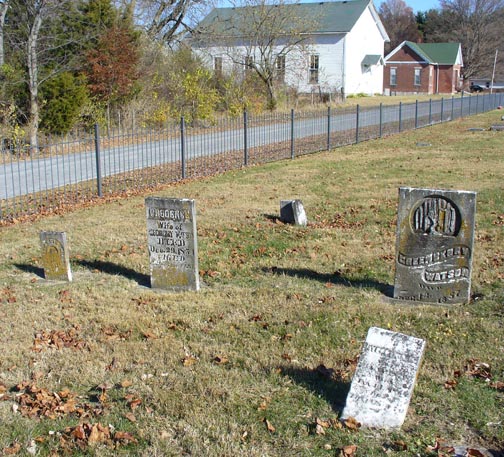
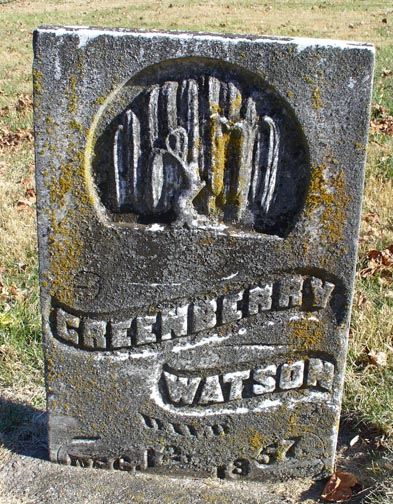
Greenberry Watson, right, and wife Prudence, left, have deeply incised tablets near the black iron fence and road near the Methodist Episcopal Church, which is in the background of the picture in the middle.
|
|
|
|
|
|
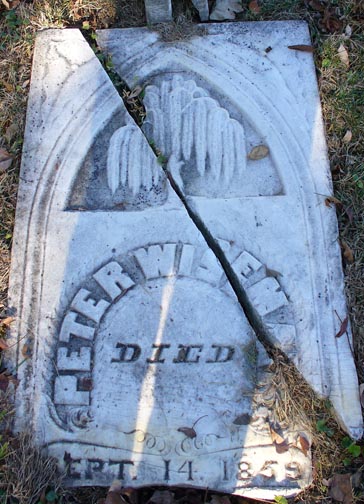
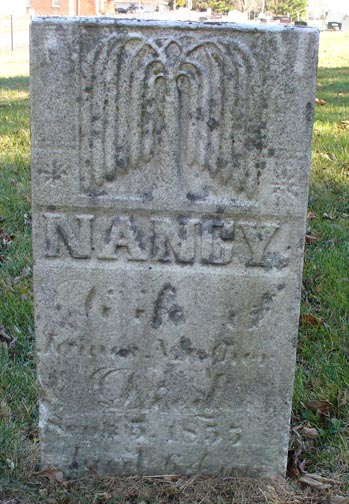
Nancy's 1855 marker, right, as well as Mr. Watson's above right, has a weeping willow at the top. In the 19th century, this carving was one of the most popular additions to any gravestone. For Victorians it symbolized the mourning of the living for the one who had passed away. Perhaps this is why this particular species of tree is nicknamed "weeping." Nancy was the wife of Francis Mather, and she was sixty-four years old when she died. Her birth year was circa 1789. Although Peter Wiseman's 1859 stone, left, is broken, the beauty of the intricate and deeply cut face is still evident. The pointed arch that frames the willow, name, and data was taken, of course, from that style of church window. The religious or spiritual implication is, therefore, obvious. |
|
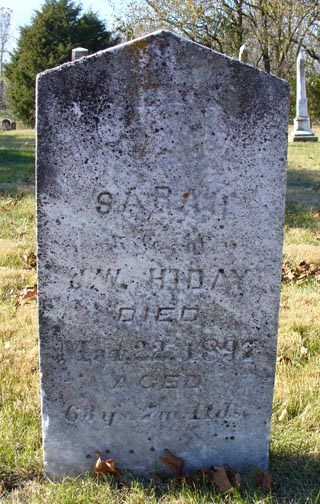
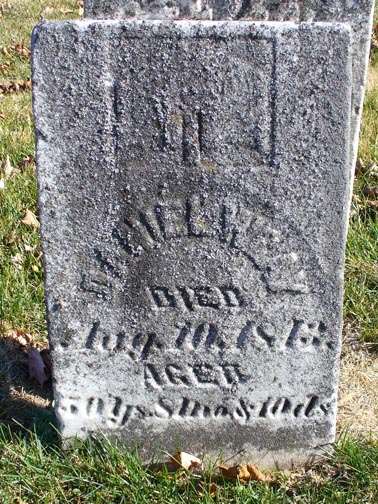
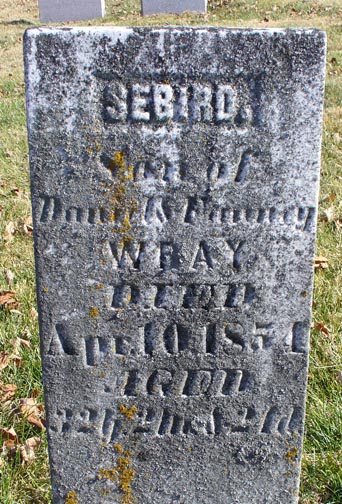
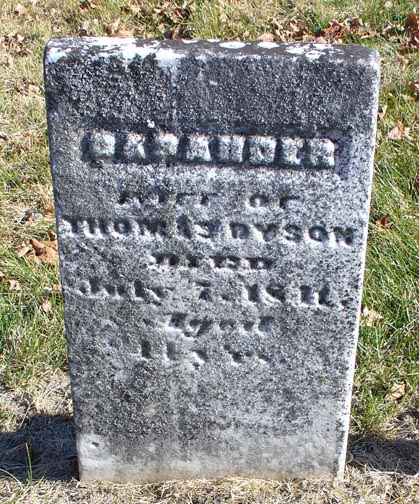
Depth of cut might have depended upon the carver's expertise and/or the family's finances. Sarah Hiday's 1897 stone, far left, is barely legible, and the clasped hands at the top have all but disappeared. She was sixty-seven when her husband was made a widower. Likewise, Daniel Wray's 1843 weeping willow, center left, can just be discerned; however, his data is quite legible. Daniel died "Aug. 19, 1843, aged 50ys. 8mo. & 10ds." Daniel would have been born circa 1793. Daniel's son Sebird, center right, died in 1854 at thirty-two years. Daniel's wife and Sebird's mother appears to have been "Emmery." At far right, "Casander wife of Thomas Dyson died July 7, 1841 aged 44." She, like Daniel, was born in one century and died in the next.
|
|
|
|
|
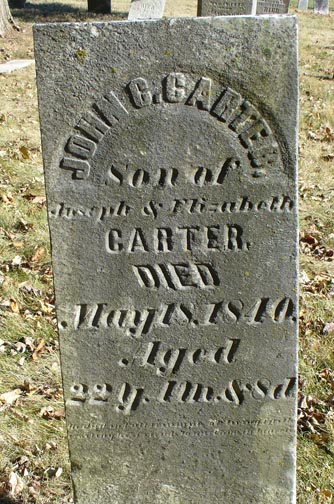
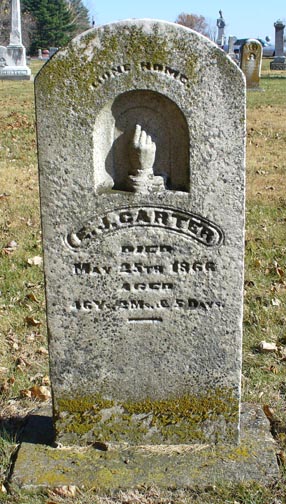
The three stones for the Carter family illustrate the mid Victorians penchant for symbols. E.J., center, who died in 1868, has a hand with index finger pointing up. This explained to viewers in the 1800s that E.J. was going to heaven, and just in case anyone found the message difficult, above the recessed hand is the phrase "Gone Home." Diannah's 1869 rounded tablet bears an anchor which symbolized that her religious faith supported and stabilized her life on earth. By contrast, John's more sever earlier tablet, left, just has his data.
|
|
|
|
|
|
|
|
|
|
|
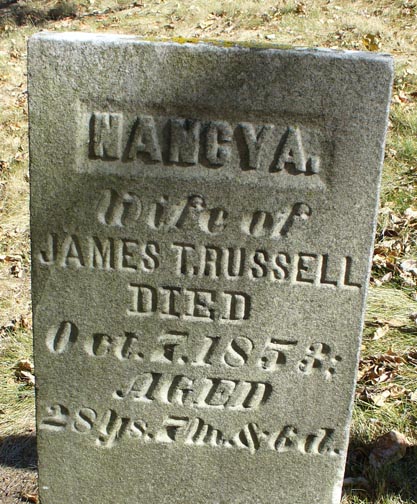
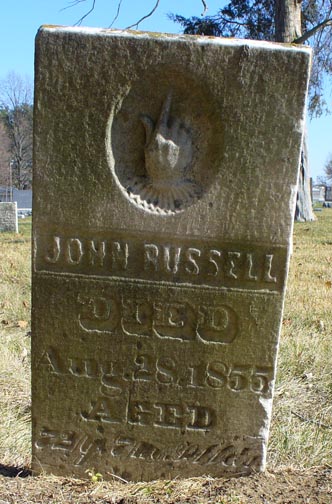
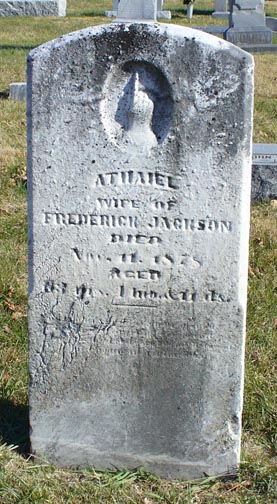
Some of the many early, simple tablet style markers in the old section are above. Additionally, the popularity of hand pointing heavenward is illustrated by John Russell's 1855 stone, left, and Athaiel Jackson's 1878 stone, right. The markers are twenty-three years apart but very similar in design. |
|
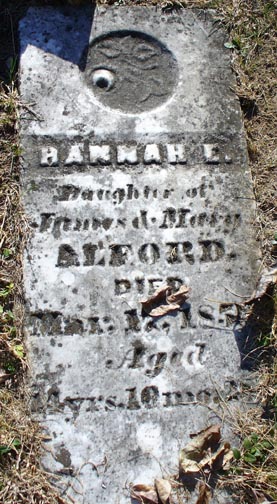
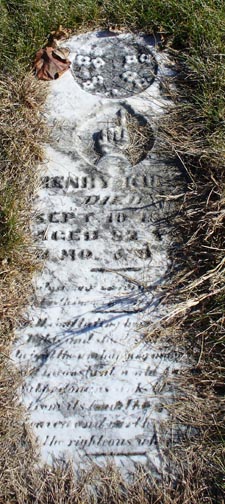
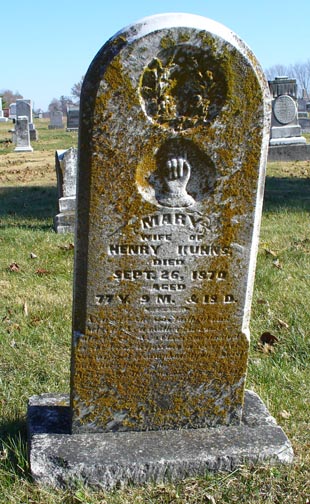
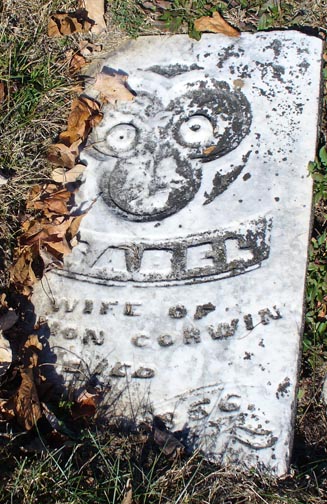
The decorations added to a gravestone might also have been dependent on the family's finances. However, by the late 1850s, the Victorians had decided that plain and simple was out of fashion and enhanced and elaborated was in. The four tablets below are all of the same basic design. The flowers at the top of each stood for love for the lost family member. At far left, Hannah, daughter of James and Mary Alford, died in 1859 when she was fourteen. Henry Kuhns, center left, was born circa 1790 and died 1872 at eight-two years. A lengthy bible verse appears in the bottom half of his marker. Henry's wife Mary died in 1879 when she was seventy-seven. Isabel Corwin died when she was thirty-three in 1856.
|
|
|
|
|
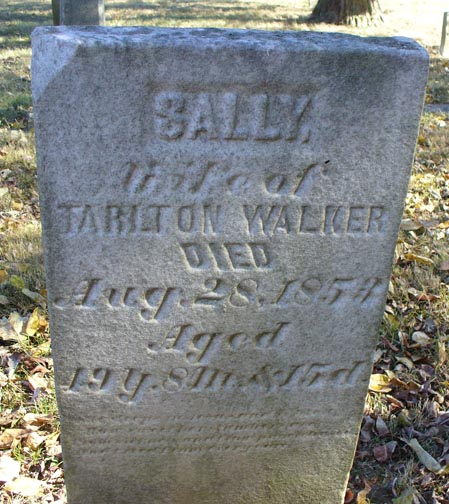
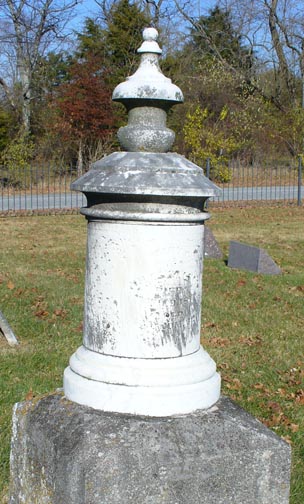
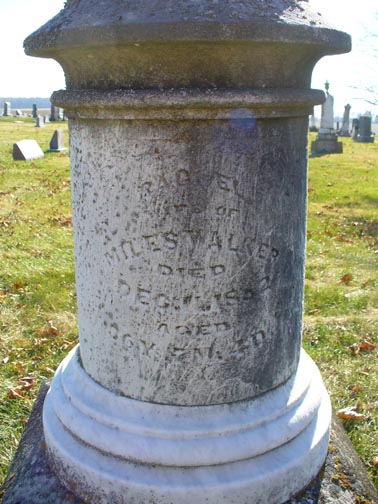
The grave markers, below, for the Walker family demonstrate the change from two dimensions to three in memorial architectural forms. Sally Walker's 1853 flat thin tablet, left, is not quite two feet tall. Rachel Walker, however, has a five foot monument, center, with a base supporting the cylinder or drum. The top half looks something like a canister with a lid and finial, and perhaps it was meant to represent an urn. Rachel's data is on the north side, right, and since she died in 1852, this marker would have been one of the first of the three dimensional type in the cemetery.
|
|
|
|
|
|
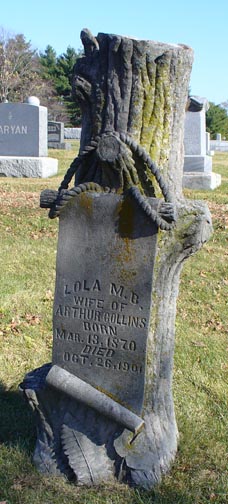
In the last half of the 1800s, Victorians liked to use natural forms in stones and monuments. While human figures were executed most of the time in shallow relief, occasionally a fuller three dimensional figure was used as for the infant, left, who died around 1870. A beautiful example of a natural form in full three dimensions is the "tree cut off," right. The stone is executed as the trunk of a tree with top and branches removed. Fallen leaves are at the base. A rope hangs the scroll with data on one of the missing limbs. The tree represented the family, and the stump of Lola Collins' branch holds her information. |
|
|
|
|
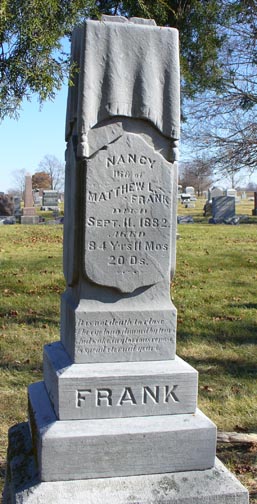
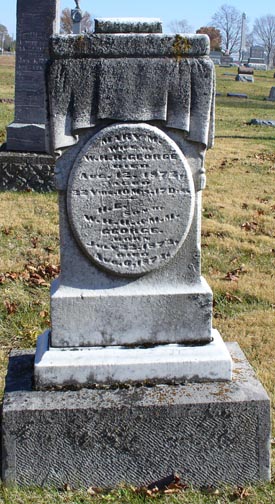
Three dimensional podiums, above, were also very popular in the last third of the 19th century. Nancy Frank, wife of Matthew, has a tall example, left. Mary M. and husband W.H.R. George have a shorter variety. On each, the book on the top was the bible, the drape with tassels represented sorrow for the departed, and a stone plaque holds the information. Nancy was born in 1798 and died in 1882 at eighty-four years. She is the only Frank listed at the Mendon. There are twelve Georges recorded.
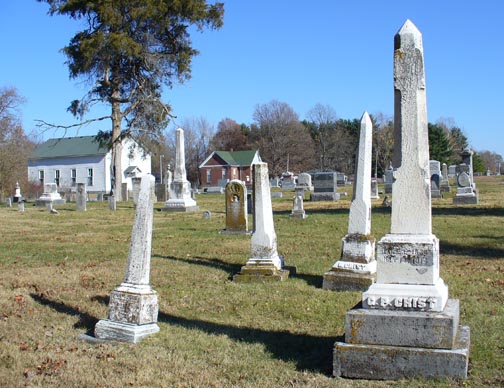
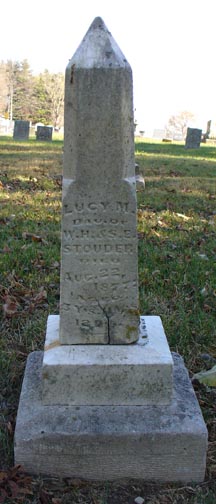
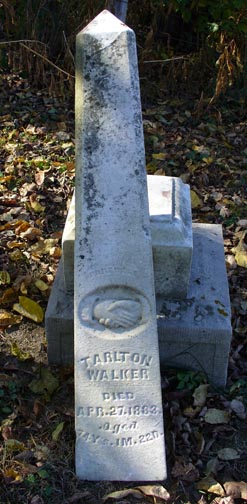
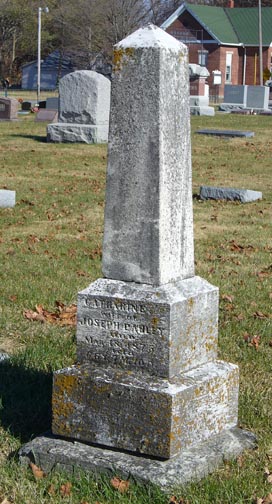
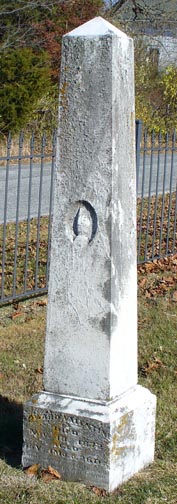
The four obelisks for the Crist family, foreground and mid ground in the photo above, illustrate how popular this symbol was with Victorians. The obelisks symbolized the spiritual connection between heaven and earth. The obelisk in the background near the tree is that for John Huston, discussed above. Shorter obelisks are shown below for Lucy Stouder, far left; Catherine Pauley, center right; and Edward Valentine, far right. Another popular symbol for married couples is shown on Tarlton Walker's stone, center left. In the oval relief are clasped hands representing the partnership of a husband and wife in life on earth and their meeting again in heaven. The stone for wife Sally Walker is discussed above.
|
|
|
|
|
|
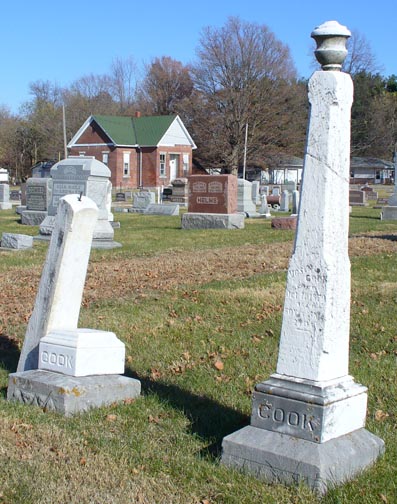
The pillars for Moses Cook, right, and wife Nancy, left, were close to matching in design. Moses' pillar has retained his finial while Nancy's has lost hers as evidenced by the rod at the top of her marker. Moses died in 1879 when he was fifty. Nancy died in 1893 when she was fifty-nine. [Obelisks, columns, or pillars? From ancient Egyptian culture, obelisks come to a point at the top which forms a pyramid. "Columns" are usually round and denote a Greek cultural reference, so "pillars" is a nice compromise.] |
|
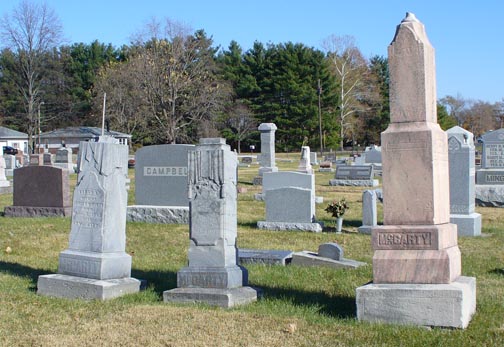
The three McCarty stones, above, show a later development in monument style. The two grays are carved as items: podiums, books, and drapes. The pink marker, right, is purely architectural. It has bases, squares, and rectangles stacked in various sizes as befitting a building. On some larger stones of this style, cornices and moldings were used as well, as in the tall gray square pillar in the center background.
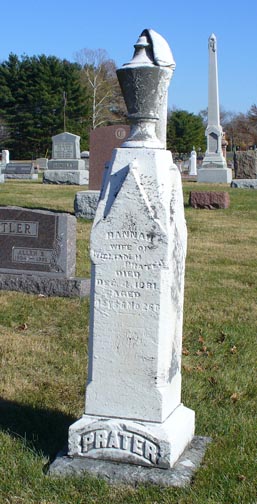
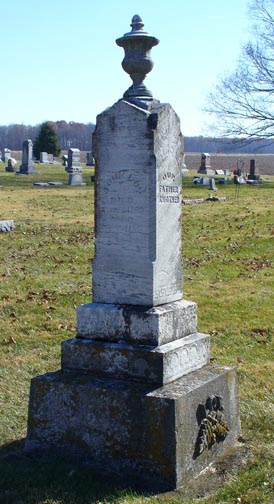
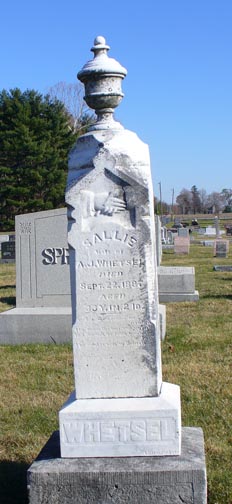
Although slightly different in details, these three architectural pillars topped by urns might easily have been done by the same carver. The urn, to people in the late 1800s, stood for the decay of all things physical, more specifically the death of the human body. While John Loy's marker, center, is less ornate, Hannah Prater's, left, has the additional drape over the urn, and Sallie Whetsel, right, has the clasped hands representing the partnership of marriage.
|
|
|
|
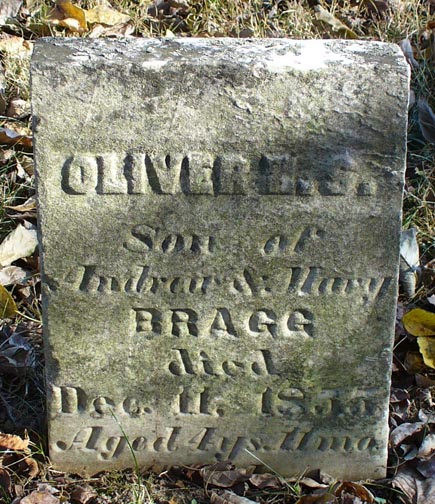
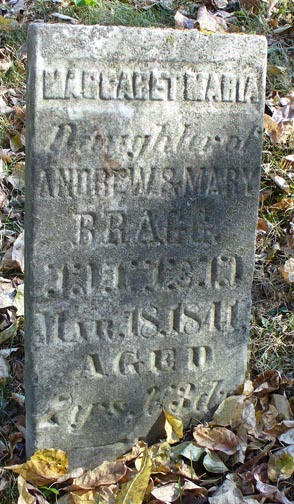
Through most of the 19th century, the death rate among the young was generally one out of four, and during epidemics of various kinds as high as one out of three. On the list of burials for the Mendon Cemetery, there are four individuals with the Bragg surname. All four are children. Two of them have legible markers. Oliver, below left, died in 1855, and Margaret Maria, below right, died in 1841. The parents for these two are recorded on their stones as "Andrew and Mary." The two without legible gravestones are listed as Joseph and Sarah. Joseph died on the same day as Margaret, April 18, 1841. While Oliver died in 1855 at four, Sarah died in 1847 at two. Presumably Joseph and Sarah were also the children of Andrew and Mary. Since neither of the parents are on record for this cemetery or any other in Madison County, perhaps after losing four young ones, the couple decided to move on. The four children are here to represent their family's time within the early Mendon community.
|
|
|
|
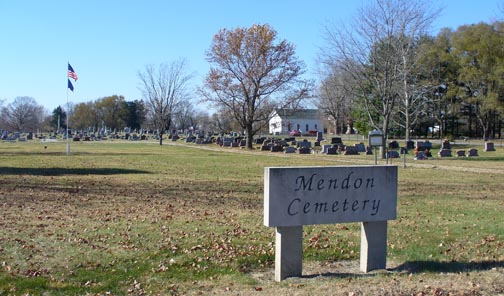
In the late 1800s, the Mendon Cemetery was taken over by an association organized to protect and perpetuate the grounds as a place for the burials of family descendants and area residents. With the original cemetery site located close to Lick Creek, land east of the old markers and abutting SR 9 was obtained and now affords enough property for the service of 21st century Madison County Hoosiers.
Modern Mendon as seen from SR 9
Click here for a list in pdf format of burials with headstones