|
Pioneer
Cemeteries and Their Stories, Madison County, Indiana |
 |
|
Pioneer
Cemeteries and Their Stories, Madison County, Indiana |
|
|


Location: north side of 1650N, between CRs 350W and 450W
Boone Township in
north-central Madison County is comprised of large expanses of farm land. The
village of Rigdon is in the extreme northwest cor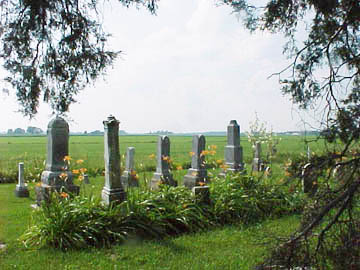 ner,
but other than that, there are no other communities or civic centers. The tree-lined
fields, unimpeded by cities and towns, gradually rise to a geographic high point
in section 21. Here with only three or four houses in sight, the Forrestville
Cemetery has a commanding view of the beauty of the surrounding Hoosier
landscape.
ner,
but other than that, there are no other communities or civic centers. The tree-lined
fields, unimpeded by cities and towns, gradually rise to a geographic high point
in section 21. Here with only three or four houses in sight, the Forrestville
Cemetery has a commanding view of the beauty of the surrounding Hoosier
landscape.
There used to be a Forrestville hamlet. It and its cemetery were laid out in 1850 by pioneer settler Rev. John W. Forrest on land which he owned and donated. Forrestville had several houses, a church, and general store, but the hamlet existed for a very short time. In spite of the disappearance of the buildings, Forrestville Cemetery continued to be used by the neighboring farmers and the members of the reverend's Baptist Church which he organized in 1853. Once again, Rev. Forrest had donated the ground for the house of worship. Later, in 1860, Forrest also gave the township a piece of land for a new school next to the church.
The 1876 plat map for Boone Township shows only the cemetery on CR 1650N, sheltered on three sides by Rev. Forrest's 160 acres; there is not even a hint of Forrestville, the hamlet. The Baptist Church and school house #5 are seen in the northeast corner of the Forrest property with the north-south road having to angle around them. The Forrest home is designated as being back a long lane off of CR 450E. The Forrest farm with house, barns, fields, and woods is pictured on page 97 in the 1880 History of Madison County, Indiana.
|
|
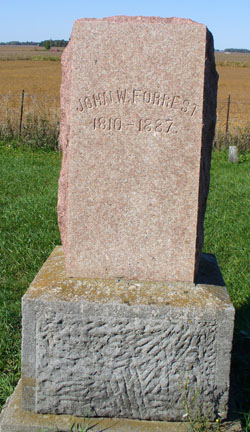
A large modern memorial has been placed by descendants for John W. Forrest, 1810-1887. It also records his wife Luna. The red granite sits next to Luna's original stone below. John W. instituted a Baptist church and accompanying cemetery, a school, and a village for his fellow Hoosier settlers. Family still reside in the county. |
|
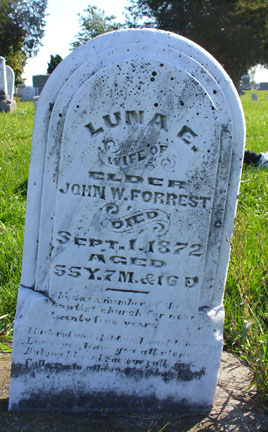
Luna Forrest's reset gravestone is a genealogist's dream: "Luna C. wife of Elder John W. Forrest, died Sept. 1, 1872, aged 55y 7m & 15d." Below that is the biographical data that she was a respected member of the Baptist Church for twenty-five years. Under this information is a traditional verse from the Bible. Most of the stone is remarkably legible without having to be "chalked" or "rubbed." |
 |
In an early publication, Madison County historian Samuel Harden gives this description of Rev. John Forrest:
"...[Forrest] was born in Virginia in December 1810 and...arrived in that part of the county when it was quite new. There were no roads, no mill, the few first years after his arrival there. Mr. F. was blessed with a strong constitution, well fitted for pioneer life; one spring he was at no less than twenty-six log rollings, which required no small amount of physical ability. He has been a member and minister of the Baptist Church for many years... He served twelve years as Justice of the Peace, and acted as Swamp Land Commissioner, and is, at this writing, a candidate for the Legislature on the Grange ticket. He has always taken a strong temperance stand...and was the first Postmaster in the township... In person, he is rather under medium size, heavy built, low forehead, heavy eyebrows, and in height about five feet seven inches... As a public speaker Mr. F. can not be said to be eloquent, yet he is listened to with attention...as a minister."
The very first settler to this township is also buried at the Forrestville. Wright Smith was born in 1798 in Virginia. He, along with his wife Lydia and six children, came in 1835. Other than his farming enterprises, Wright Smith helped organize in 1851 one of the first churches in the township, the Methodist Episcopal. Smith was elected class leader and erected a house of worship for the congregation at his own expense. He also served as superintendent of the church's Sunday school, a position he held for ten years until his death in 1863. Wright Smith was described by county historian Samuel Harden as "tall, slim, with dark complexion and dark hair... He was on the right side of all moral questions. His memory should be kept green for the sterling qualities and noble ambition, which were characteristic of the man."
|
|
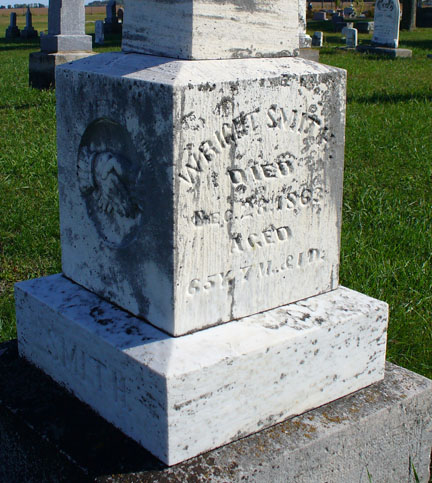
Wright Smith's tall column, left, stands on the west side of the cemetery. The monument overlooks a beautiful expanse of open Hoosier farmland he pioneered. As his base testifies: "Wright Smith died Dec. 23, 1863 aged 65y 7m 1d." Nearby, relative James S. has a podium with mourning shawl and bible. James died "Nov. 28, 1874 aged 51y 1m 28d." |
|
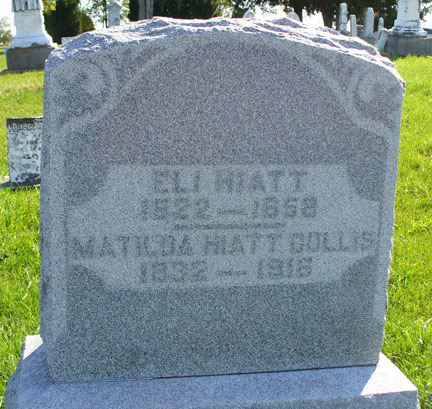
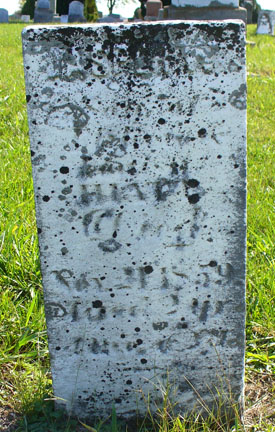
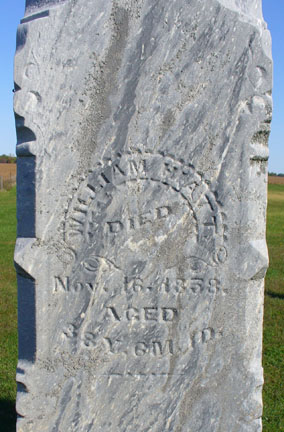
Following closely behind the Smiths were the Hiatts. A William Hiatt is listed among first land owners for Boone Township. The patriarch of the family, also named William, died in 1839 at "71y 10m 9d" according to the burial list. That would make his birth year about 1768--before the Revolutionary War. A second William, possibly a son, died in 1858 at thirty-three years of age; an Eli Hiatt also passed away in that year. Like the Forrests, the Hiatts have many descendants living still in the county.
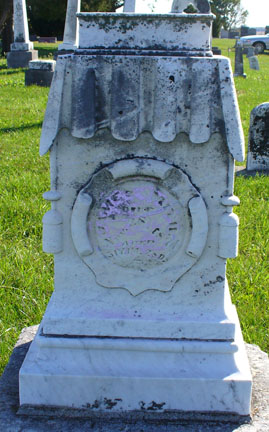
Eli, left, and William, right, both have replacement monuments erected by their descendants. The stone type, size, and design are from the late 19th or early 20th century. Jasper's stone, middle, is the soft white marble tablet used in the 1850s.
|
|
|
|
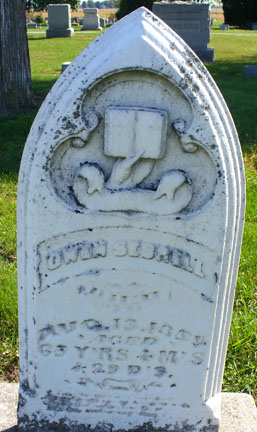
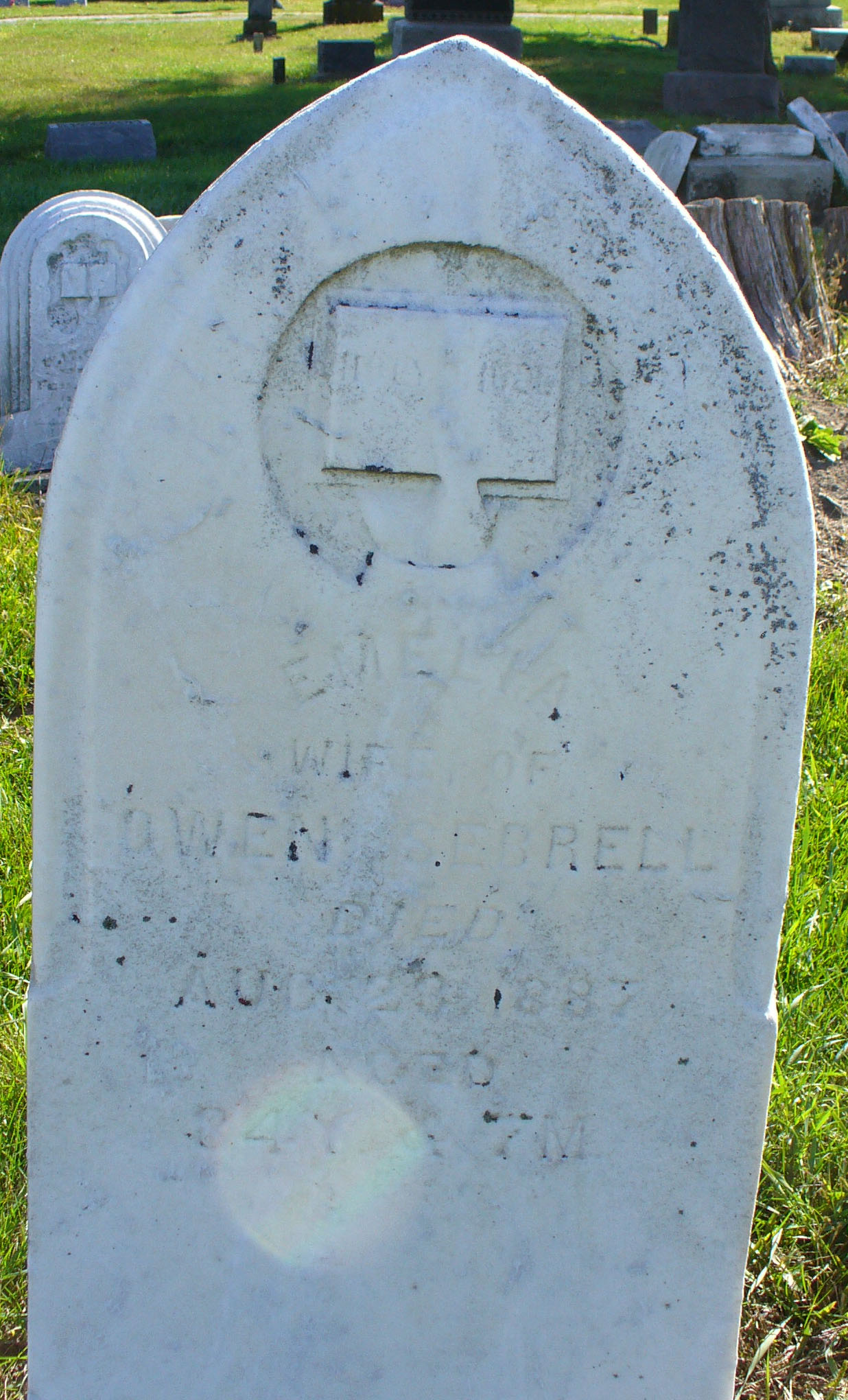
Another first family were the Sebrells. Benjamin H. and Morgan Sebrell are listed by 19th century Madison County historian Samuel Harden as first land owners along with the Greenlees, McMahans, Fenimores, and Moores, etc.
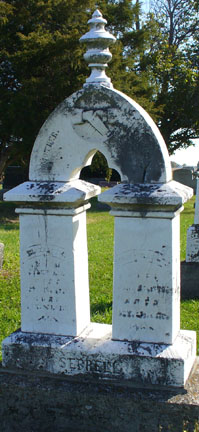
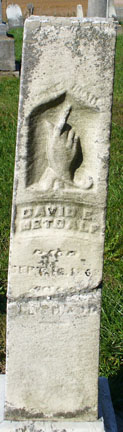
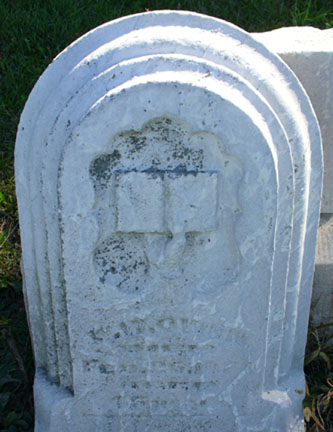
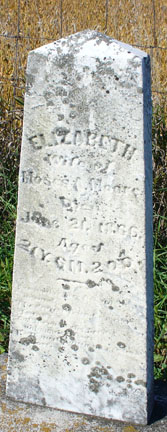
The Sebrells have attractive, legible stones representing their contribution. Owen, left, and his wife Emelia, middle, each have a hand holding a bible within a cartouche. The hand with bible symbolized their religious faith. The stones' design of the pointed arch suggested the arched windows of many churches during the last half of the 19th century. At right, Benjamin and wife Elizabeth's memorial is also symbolic. The single base with two pillars topped by a connecting arch represented their marriage as one unit. The clasped hands at the top of the arch also symbolized their partnership. This example is surmounted by a decorative finial.
|
|
|
|
|
|
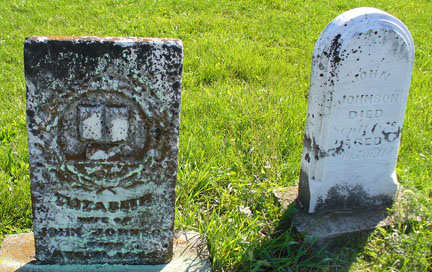
In contrast, the Johnsons have dissimilar stones--though they are buried next to each other as the picture, left, shows. Elizabeth, "wife of John Johnson," died in 1868 when fifty-five. John lived to be eighty-nine and died in 1872. That would make his birth year about 1781. This wife and husband are the only ones with the surname Johnson on the Forrestville Cemetery burial list. |
|
|
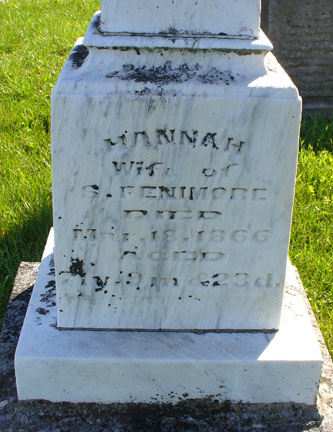
Hannah Fenimore's stone proclaims that she too was born in the 18th century. She died in 1866 at seventy-one years of age. That would make her birth year about 1795. |
|
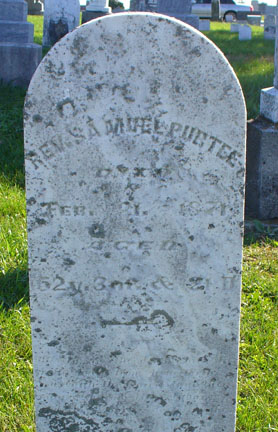
In addition to Wright Smith and John Forrest, who both started churches in the area, Samuel Purtee's stone testifies that he was a reverend although the denomination of his faith is not given. The reverend "died Feb. 21, 1871 aged 52y 3m 21d." Relative James Purtee, from the previous generation, died at seventy-two in 1859 according to earlier gravestone transcriptions. Churches were second only to personal shelters for the family in being erected in pioneer rural communities. |
|
|
|
|
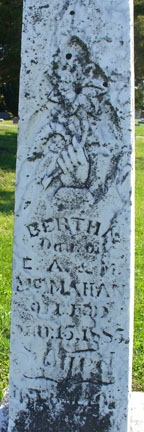
These two McMahan stones have popular symbols from the 19th century. At far left, Bertha's pillar has a hand holding flowers. The flowers, of course, represented love for the departed. Bertha was the "daughter of E.A. and M. McMahan," and she died in 1885 when she was sixteen. Joel's stone, left, has the compass with right angle rule which meant that he was a member of the Freemasons. Joel died in 1873 when he was thirty-two. The metal star with "GAR" printed in the center signifies a veteran of the Civil War. |
|
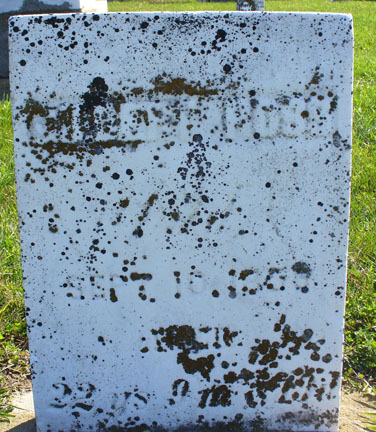
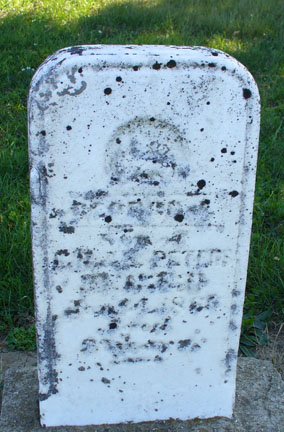
The most common style of stone in 19th century cemeteries is the simple basic tablet like the two on the right. These were not that expensive and made of soft, easily carved white marble. Unfortunately, this soft material is prone to discolor with mold and fungus, as seen here, and they are also apt to break off at the base. If individuals are on the attached burial list but do not now have a stone representing them, then most likely the marker was such as these. At right, a son of the Adamson family, "Nathani.", an abbreviation for Nathaniel, died in 1871 at just one year old. The blue on the stone is sidewalk chalk used to bring out the lettering. It does not harm the stone and will wash off in the next rain. At far right, Gilbert Ross died in 1850 at twenty-two.
|
|
|
|
|
|
|
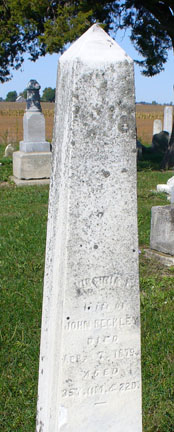
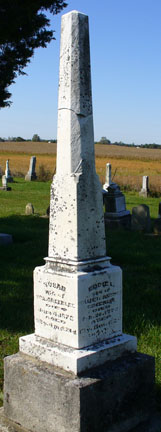
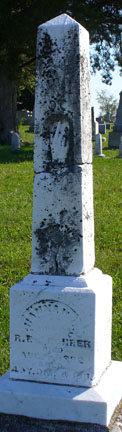
Three dimensional markers became the fashion in the last third of the 19th century. One popular design was the obelisk which represented the spiritual connection between heaven and earth. At far left, this faded pillar represents the only person with the Wright surname on record as buried at this location: William Wright died in 1885 when seventeen. Center left is an almost identical stone for "Virginia C. wife of John Beckley died Apr 7, 1879 aged 35y 11m 22d." Center right is a well preserved obelisk on base and foundation. A monument of this design was often set at the center of graves with each side of the base recording who was buried at that spot. On the south face is Susan Greenlee, who died in 1873 at ninety-eight years of age. She would have been born during the Revolutionary War. On the east face Eddie L. Greenlee is recorded as passing away in 1875 when nineteen. At far right is a shorter obelisk on base and small foundation. This is for "Hannah G. wife of R.E. Rohrer" who died at forty-nine in 1882.
|
|
|
|
|
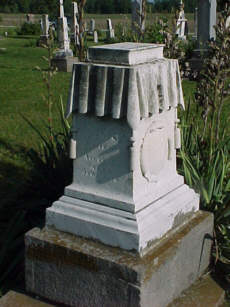
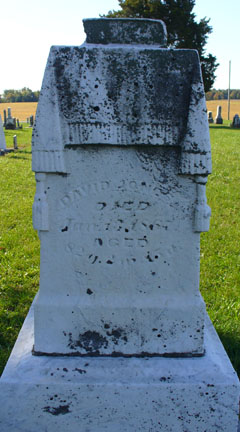
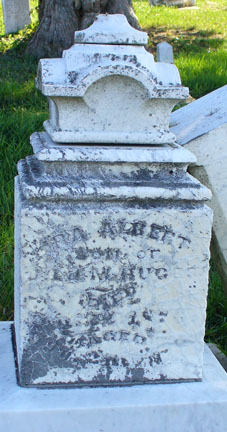
For the families who wanted the stones for their departed to testify to religious faith, the "podium" was a popular choice. A short rectangular column was covered with a stone drape, often with tassels and fringe. The book on top was the bible. Like the obelisk, the podium was often placed between or at the center of graves, and each side gave the data for individual family member. James and wife Amanda Ross's gravestone is left. The scrolled medallion on the front has the family name. The right side, as one is facing the stone, gives the husband's statistics; the left has the wife's. David Jones, another one born in the 1700s, is memorialized, center. He was born around 1785; he died in 1867 at eighty-two years of age. There are eighteen of that surname on the burial list. At right, a daughter of the McGraw family, Annie, died in 1876. This grave marker, by some oversight, was omitted during the transcription.
|
|
|
|
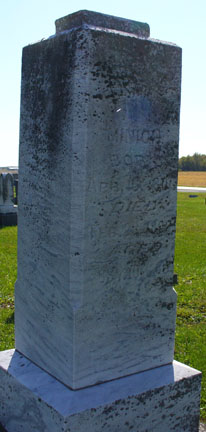
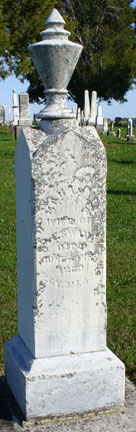
Rather than depicting a recognizable form, some three dimensional stones were essentially architectural in design such as these blocks below. The small square block at far left has a cornice on top and weathered data. Center left, Elizabeth Minch, who died in her nineties in the 1890s, has a plain pillar with a bible. At far right is another short pillar, the top of which has pointed arches. At center right is the same design but with the addition of an urn. The urn symbolized a productive life.
|
|
|
|
|
|
Always a dramatic marker in any cemetery, "a tree cut off," right, is another example of late 19th century gravestone design. This one is for Rebecca Bucy who died "Nov. 9, 1886 aged 29y 11m 2d." |
|
|
|
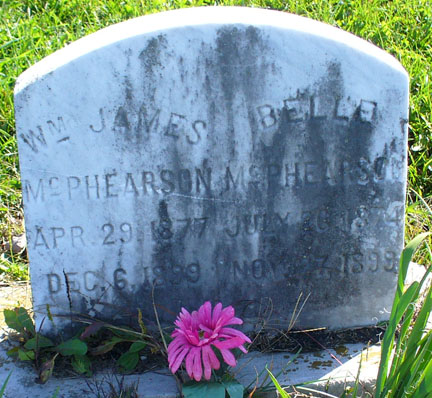
Appreciative family historians abound in Madison County as evidenced by the simple decoration at the gravestone for William and Belle McPhearson who died ten days apart in 1899. |
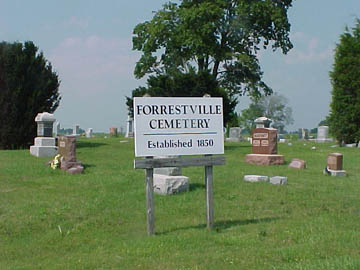
The Forrestville Cemetery continues to be used by local residents and descendants of settlers, and the land rises to a geographic high point beyond the entrance of the cemetery.
 |
Click here for a list in .pdf format of burials with headstones.